PC Statistics 2026: Windows Market Share, Lifespan, Failure Rates and Repair
Windows market share, PC shipments, lifespan, failure rates, repair and e-waste: 132 figures, each with its source and year.
Updated November 5, 2026
This page brings together 132 statistics about personal computers, from Windows market share and PC shipments to drive failures, repair and e-waste. Every figure links to its source and names the year and the sample it describes. We last checked all of them against their sources on November 5, 2026.
Key takeaways
- Windows accounted for 76.65% of desktop web traffic worldwide in October 2026 on Statcounter, and other samples range from 69.21% on US government websites to 93.70% among Steam users.
- Windows 11 reached 74.29% of Windows desktop web traffic worldwide on Statcounter in October 2026, up from 55.18% in October 2025, the month Windows 10 support ended.
- Worldwide PC shipments fell between 20.1% and 22.4% year over year in Q3 2026, according to IDC, Omdia, Counterpoint and Gartner, with totals from 55.4 million to 62.7 million units.
- In 2024, 96.6% of US households had a computing device of some kind, but only 80.5% had a desktop or laptop.
- Published laptop lifespans run from 4 years (Apple’s modelling assumption) to 7 years (a European consumer survey), and those figures measure different things.
- In a 2024 Consumer Reports survey, 12% of US adults whose portable device broke in a non-battery way repaired it, while 58% replaced it.
- The world generated 62 billion kg of e-waste in 2022, and 22.3% of it was documented as formally collected and recycled.
Contents
- Desktop operating system market share
- Windows 11 adoption after Windows 10’s end of support
- PC shipments and the PC market
- Who has a computer
- What’s inside PCs today
- Hard drive and SSD failure rates
- How long PCs last
- Repair and right to repair
- E-waste
- Malware and tech support scams
- Backups and data loss
- The people who fix and code
Desktop operating system market share
Windows is the main desktop system in every sample here, but its share runs from 65.4% to 93.70% depending on who is counted, and Statcounter's monthly figure has swung sharply during 2026.
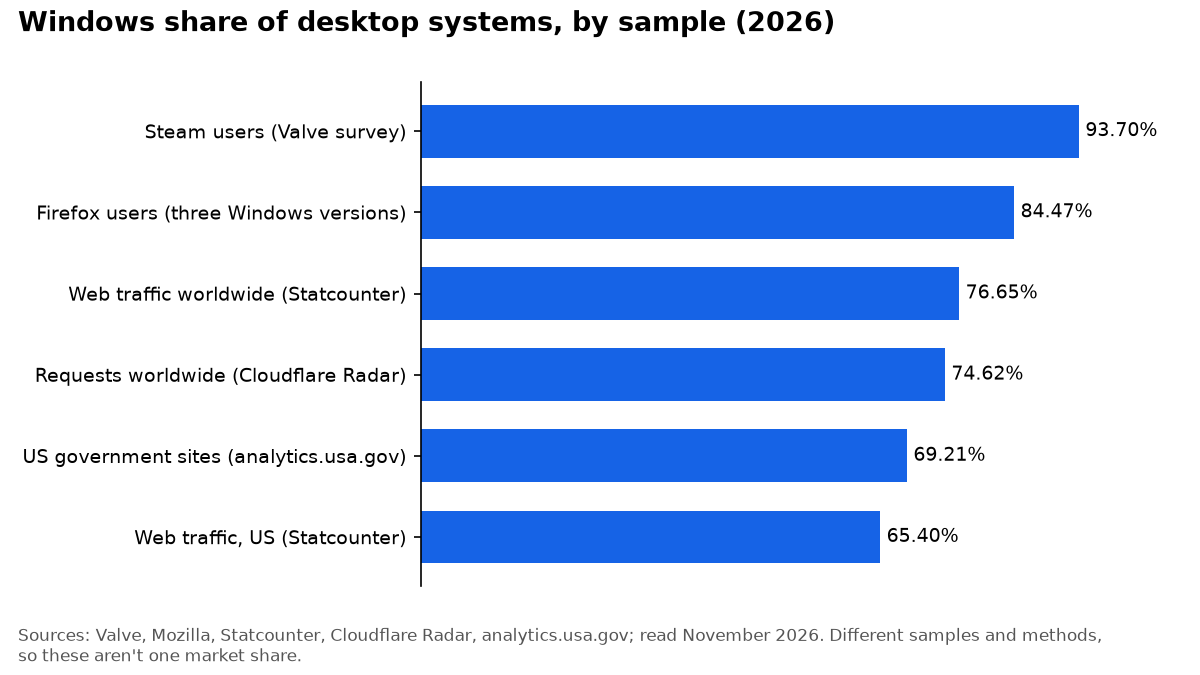
- Windows accounted for 76.65% of desktop and laptop web traffic worldwide in October 2026, according to Statcounter’s page-view sample. (Source: Statcounter Global Stats: Desktop OS market share, worldwide, 2026)
- Apple’s desktop systems took a combined 15.67% of desktop web traffic worldwide in October 2026 on Statcounter, which lists OS X and macOS separately: 9.86 + 5.81 = 15.67. (Source: Statcounter Global Stats: Desktop OS market share, worldwide, 2026)
- In the United States, Windows held 65.4% of desktop web traffic in October 2026 on Statcounter, with OS X and macOS listed separately at 15.92% and 8.51%. (Source: Statcounter Global Stats: Desktop OS market share, United States, 2026)
- When Statcounter’s June 2026 worldwide table was captured on July 9, 2026, it showed Windows at 56.61% of desktop web traffic with 21.45% in an Unknown row; excluding Unknown puts Windows at 56.61 / (100 - 21.45) = 72.07%. (Source: Statcounter Global Stats: Desktop OS market share, Internet Archive capture of July 9, 2026)
- Over the 28 days to November 5, 2026, Cloudflare Radar attributed 74.62% of likely-human desktop HTTP requests worldwide to Windows, 19.55% to macOS and 4.36% to Linux. (Source: Cloudflare Radar: HTTP requests by operating system, desktop, likely human, 2026)
- Windows made up 69.21% of desktop-OS active users on US federal government websites from October 2025 to September 2026, an audience that includes some visitors from outside the US: 5,926,888,880 / (5,926,888,880 + 1,839,054,118 + 636,776,425 + 160,587,385). (Source: analytics.usa.gov (Digital Analytics Program): Operating systems, previous fiscal year, 2026)
- In Valve’s October 2026 survey of Steam users, 93.70% of systems ran Windows, 3.95% Linux and 2.35% macOS. (Source: Steam Hardware & Software Survey, October 2026)
- Among Firefox desktop release-channel users in the week of October 26, 2026, Windows 11, Windows 10 and Windows 7 together made up 84.47%: 51.16 + 29.04 + 4.27, in Mozilla’s weekly hardware report. (Source: Mozilla Firefox Public Data Report: Hardware Across the Web, operating system data, 2026)
Windows 11 adoption after Windows 10's end of support
A year after Windows 10 support ended, Windows 11 leads in every sample here, while Windows 10 still holds about a quarter of Windows desktop traffic worldwide on Statcounter and 39.27% in China.
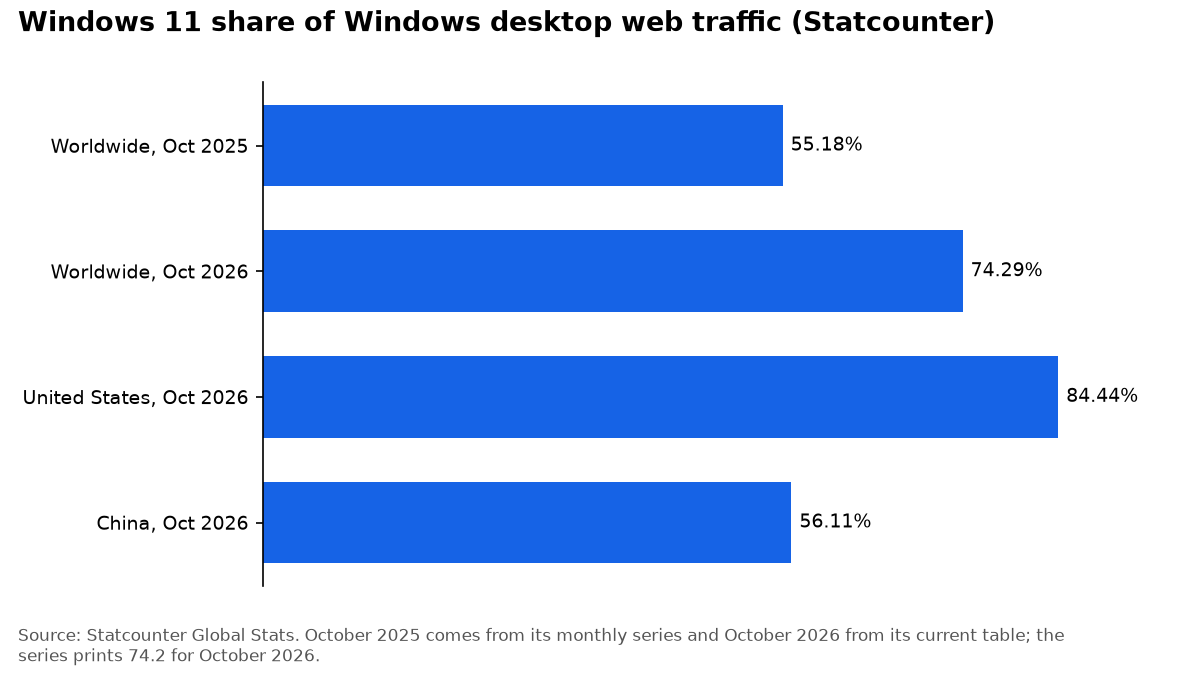
- Windows 11 accounted for 74.29% of Windows desktop web traffic worldwide in October 2026 on Statcounter, against 25.13% for Windows 10. (Source: Statcounter Global Stats: Desktop Windows version market share, worldwide, 2026)
- Statcounter’s monthly series has Windows 11 at 55.18% of Windows desktop web traffic worldwide in October 2025, the month Windows 10 support ended, and at 74.2% in October 2026. (Source: Statcounter Global Stats: Desktop Windows version series, CSV export, Oct 2025 to Oct 2026)
- In the United States, Windows 11 reached 84.44% of Windows desktop web traffic in October 2026 on Statcounter, with Windows 10 at 15.09%. (Source: Statcounter Global Stats: Desktop Windows version market share, United States, 2026)
- China lagged the US on Statcounter in October 2026, with Windows 11 at 56.11% of Windows desktop web traffic, Windows 10 at 39.27% and Windows 7 still at 4.24%. (Source: Statcounter Global Stats: Desktop Windows version market share, China, 2026)
- In Valve’s October 2026 survey of Steam users, 72.51% of all systems ran 64-bit Windows 11 and 21.11% ran 64-bit Windows 10. (Source: Steam Hardware & Software Survey, October 2026)
- Microsoft ended support for Windows 10 Home and Pro on October 14, 2025, with version 22H2 as the last release. (Source: Microsoft Learn: Windows 10 Home and Pro lifecycle, 2025)
- Microsoft told investors on its January 2026 earnings call that Windows had reached 1 billion Windows 11 users, up over 45% year over year, for the quarter ended December 2025. (Source: Microsoft Fiscal Year 2026 Second Quarter Earnings Conference Call, 2025)
- Microsoft’s consumer Extended Security Updates for Windows 10 cost a one-time $30 USD, or come at no added cost with Windows Backup settings sync or 1,000 Microsoft Rewards points, and Microsoft added a year in June 2026 so coverage runs through October 12, 2027. (Source: Windows Experience Blog: Stay secure with Windows 11, Copilot+ PCs and Windows 365 before support ends for Windows 10, 2026)
- Organizations pay Microsoft $61 USD per device for the first year of Windows 10 Extended Security Updates, and the price doubles each consecutive year for up to three years, with later buyers also paying for earlier years. (Source: Microsoft Learn: Extended Security Updates (ESU) program for Windows 10, 2025)
- Lansweeper’s data on its customers’ IT assets, published in July 2026, put Windows 11 on 78.8% of Windows devices and Windows 10 on 16.9%. (Source: Lansweeper: Windows 10 Holdouts Carry Three Times the Risk of Windows 11, 2026)
- In Mozilla’s report for the week of October 26, 2026, 51.16% of Firefox desktop release-channel users were on Windows 11 and 29.04% on Windows 10. (Source: Mozilla Firefox Public Data Report: Hardware Across the Web, operating system data, 2026)
PC shipments and the PC market
Four trackers put the Q3 2026 drop in PC shipments between 20.1% and 22.4%, after growth in 2025, and analysts point to memory and component costs; their totals differ because each counts a different set of products.
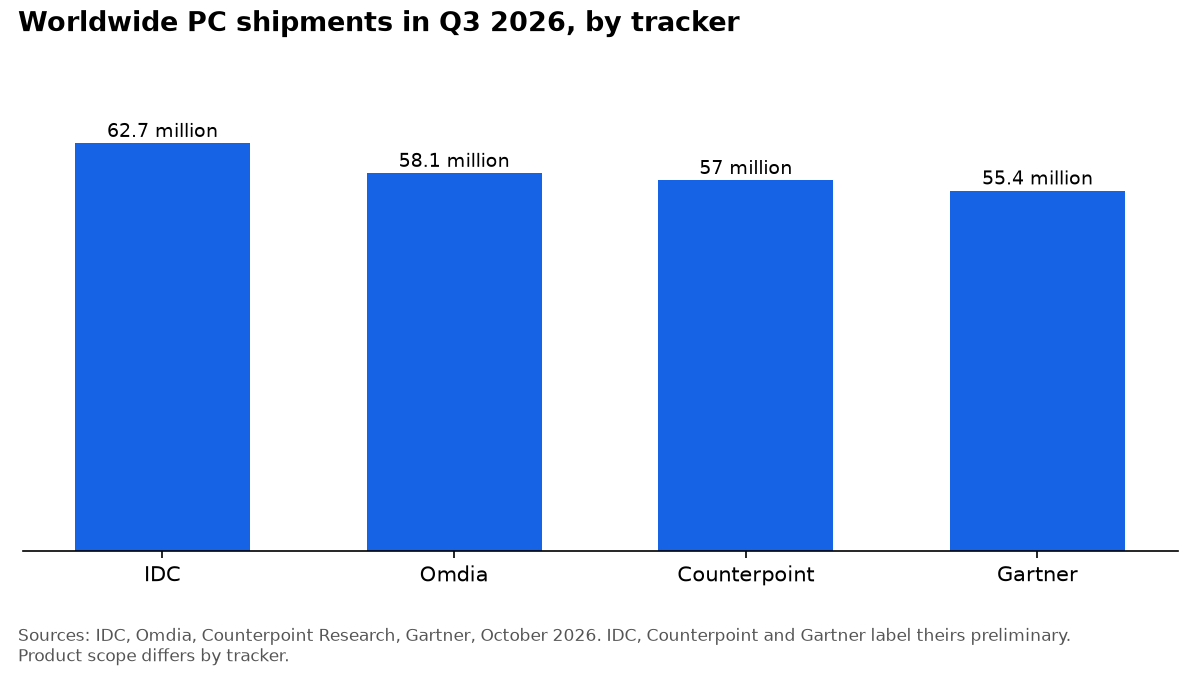
- Gartner’s preliminary count put worldwide PC shipments at 55.4 million units in the third quarter of 2026, down 22.4% from the third quarter of 2025 (desktops and laptops running Windows, macOS or Chrome OS, counted as shipments into sales channels). (Source: Gartner: Worldwide PC shipments declined 22.4% in Q3 2026 (press release, October 12, 2026))
- IDC’s preliminary tracker data put worldwide PC shipments at 62.7 million units in Q3 2026, down 20.1% year over year; IDC counts desktops, notebooks and workstations and excludes tablets and x86 servers. (Source: IDC: PC Market Woes Continue, Shipments Fall 20.1% in Q3 2026 (press release, October 8, 2026))
- Omdia counted 58.1 million desktops, notebooks and workstations shipped worldwide in Q3 2026, down 21.2% year on year: 46.4 million notebooks (down 20.6%) and 11.7 million desktops (down 23.5%). (Source: Omdia: Global PC shipments fall 21% in 3Q26 as pull-forward demand subsides (press release, October 9, 2026))
- Counterpoint Research’s preliminary data put global PC shipments at 57 million units in Q3 2026, down 21% from a year earlier and 13.8% from the previous quarter. (Source: Counterpoint Research: Global PC Shipments Plunge 21% in Q3 2026 (October 22, 2026))
- Before the slump, Gartner’s preliminary count showed worldwide PC shipments rising 4% to 62.8 million units in Q1 2026, a gain Gartner attributed to vendors and distributors building inventory ahead of expected price rises, not to real demand. (Source: Gartner: Worldwide PC shipments increased 4% in Q1 2026 (press release, April 10, 2026))
- IDC’s preliminary full-year total for 2025 was 284.7 million PCs shipped worldwide, up 8.1% from 263.3 million in 2024. (Source: IDC: 2025 Holiday PC Shipments Exceed Expectations (press release, January 12, 2026))
- Gartner’s narrower count for full-year 2025 was 270,218 thousand PCs shipped worldwide, a preliminary figure up 9.1% from 247,646 thousand in 2024; Gartner’s scope is desktops and laptops running Windows, macOS or Chrome OS. (Source: Gartner: Worldwide PC shipments increased 9.3% in Q4 2025 and 9.1% for the full year (press release, January 20, 2026))
- In IDC’s preliminary Q3 2026 table, Lenovo led worldwide PC shipments with 14.9 million units and a 23.8% share, ahead of HP Inc (16.5%), Dell Technologies (12.1%), Apple (9.5%) and ASUS (8.7%). (Source: IDC: PC Market Woes Continue, Shipments Fall 20.1% in Q3 2026 (press release, October 8, 2026))
- All of the top six PC vendors lost volume in Q3 2026 in Gartner’s preliminary count: HP Inc. fell the most, down 30.9%, while Apple fell the least, down 7.1%, and gained share. (Source: Gartner: Worldwide PC shipments declined 22.4% in Q3 2026 (press release, October 12, 2026))
- Gartner’s February 2026 forecast expected worldwide PC shipments to fall 10.4% in 2026 compared with 2025; this is a forecast, made before the third-quarter drop. (Source: Gartner: Surging memory costs will reduce global PC and smartphone shipments in 2026 (press release, February 26, 2026))
- Omdia analyst Ben Yeh said in October 2026 that DRAM and SSDs had risen from a typical share of around 15% of a PC’s cost to nearly 40%, with their prices up more than fourfold. (Source: Omdia: Global PC shipments fall 21% in 3Q26 as pull-forward demand subsides (press release, October 9, 2026))
Who has a computer
Almost every US home has some computing device, but about one in five has no desktop or laptop, because the Census Bureau's wider measure counts smartphones and tablets.
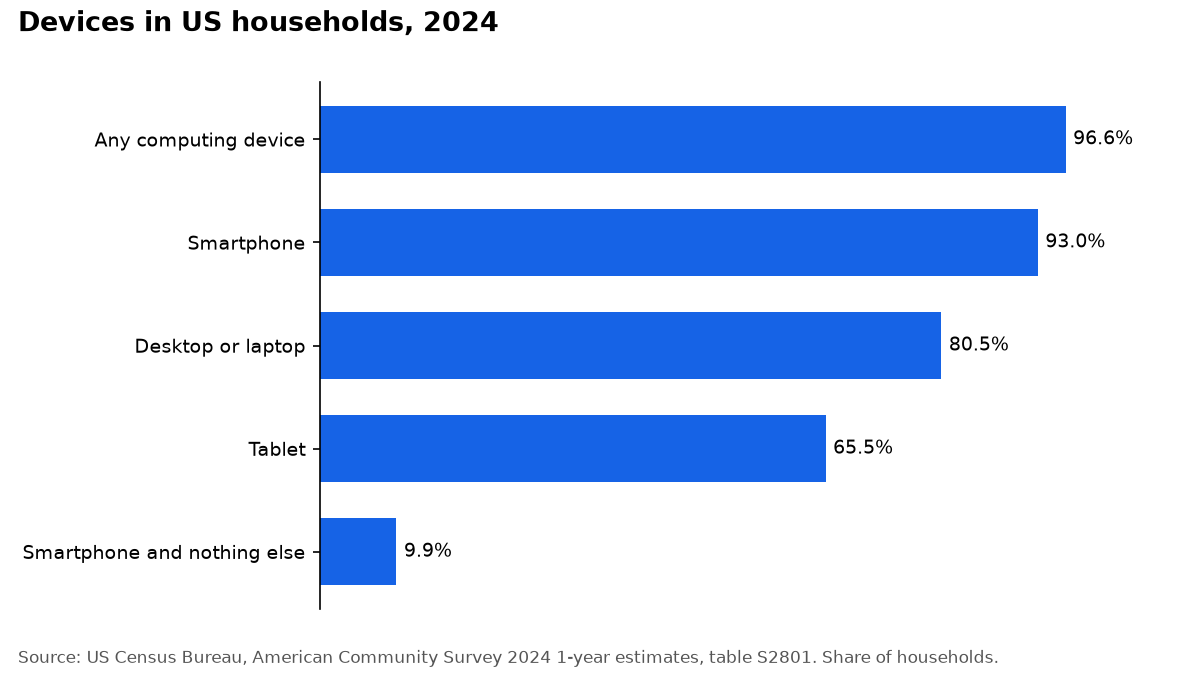
- In the Census Bureau’s 2024 American Community Survey, 96.6% of the 132,737,146 US households had at least one computing device, a measure that counts smartphones and tablets as computers. (Source: U.S. Census Bureau: American Community Survey 2024 1-year, Table S2801 (United States))
- Only 80.5% of US households had a desktop or laptop computer in the 2024 American Community Survey, 16.1 percentage points below the 96.6% with any computing device (96.6 - 80.5 = 16.1). (Source: U.S. Census Bureau: American Community Survey 2024 1-year, Table S2801 (United States))
- Smartphones were the most common computing device in US homes in the 2024 American Community Survey, present in 93.0% of households. (Source: U.S. Census Bureau: American Community Survey 2024 1-year, Table S2801 (United States))
- Tablets or other portable wireless computers were in 65.5% of US households in the 2024 American Community Survey. (Source: U.S. Census Bureau: American Community Survey 2024 1-year, Table S2801 (United States))
- A smartphone was the only computing device in 9.9% of US households in the 2024 American Community Survey, or 13,195,205 households. (Source: U.S. Census Bureau: American Community Survey 2024 1-year, Table S2801 (United States))
- In Pew Research Center’s 2026 fact sheet, based on surveys of US adults including one of 5,511 adults, 16% were smartphone-only internet users: they own a smartphone but have no home broadband. (Source: Pew Research Center: Americans’ Use of Mobile Devices in 2026 (fact sheet))
- In a Pew Research Center survey of 1,391 US teens in fall 2024, 88% said they have or have access to a desktop or laptop at home, against 95% for a smartphone. (Source: Pew Research Center: Teens, Social Media and Technology 2024)
- In NTIA’s November 2023 Internet Use Survey, about 20.3% of Americans ages 3 and older used a desktop computer (proportion 0.202694 x 100), down from about 28.1% in 2021 (0.281157 x 100), while about 53.6% used a laptop (0.536462 x 100). (Source: NTIA: Internet Use Survey dataset, Data Explorer analysis table, 2023)
- Across the EU in 2025, 56% of individuals connected to the internet through a laptop and 31% through a desktop computer, while almost 9 in 10 used a mobile device, according to Eurostat. (Source: Eurostat: Digital economy and society statistics, households and individuals, 2025)
- NCES reports that in 2023, 92.4% of US children ages 3 to 18 had home internet access through a computer (a definition that includes tablets), 5.4% had it only through a smartphone, and 2.3% had none. (Source: NCES Digest of Education Statistics 2024, Table 702.12, 2023)
- In Common Sense Media’s 2024 survey of 1,578 US parents, 85% of children ages 0 to 8 lived in a home with a laptop or desktop computer, compared with 91% in the group’s 2017 survey. (Source: Common Sense Media: The 2025 Common Sense Census: Media Use by Kids Zero to Eight (report PDF), 2024)
- ITU estimated that 49.7% of households worldwide had a computer in 2019, ranging from 82.3% in developed countries to 9.5% in the least developed countries. (Source: ITU: Measuring digital development, Facts and Figures 2019)
What's inside PCs today
16 GB is the most common memory size among Steam users, while Firefox users, a broader group, more often have 8 GB than 16 GB, so a gaming survey isn't a guide to the typical PC.
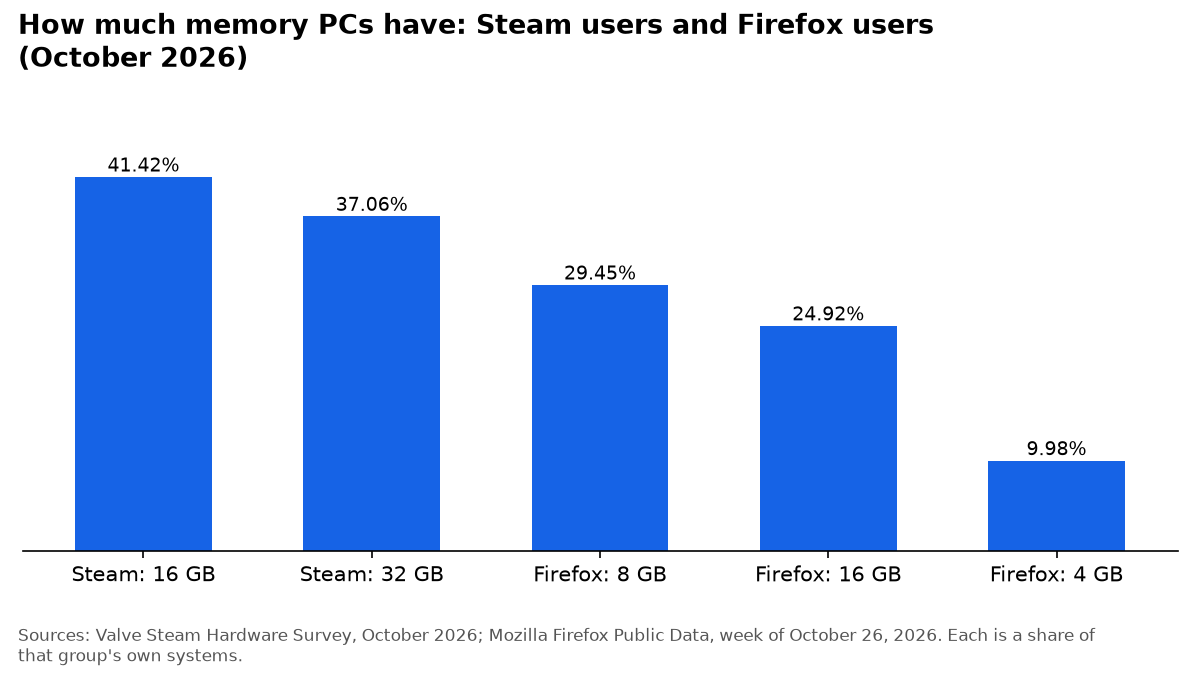
- 16 GB was the most common memory size in Valve’s October 2026 survey of Steam users, at 41.42% of systems. (Source: Steam Hardware & Software Survey, October 2026)
- 32 GB of RAM was in 37.06% of systems in Valve’s October 2026 survey of Steam users, down 5.16 points in a month. (Source: Steam Hardware & Software Survey, October 2026)
- Eight physical CPU cores was the most common setup in Valve’s October 2026 survey of Steam users, at 28.68% of systems, just ahead of six cores at 27.29%. (Source: Steam Hardware & Software Survey, October 2026)
- In Mozilla’s report for the week of October 26, 2026, 29.45% of Firefox desktop release-channel users had 8 GB of RAM, 24.92% had 16 GB and 9.98% had 4 GB. (Source: Mozilla Firefox Public Data Report: Hardware Across the Web, memory data, 2026)
- In the same Firefox report for the week of October 26, 2026, Intel supplied the processor in 77.20% of desktop users’ machines, AMD in 17.22% and Apple in 5.12%. (Source: Mozilla Firefox Public Data Report: Hardware Across the Web, CPU vendor data, 2026)
- Mercury Research put AMD at 30.3% of x86 client CPU unit shipments in Q2 2026, a record, with 34.9% of desktops and 28.9% of notebooks, per Tom’s Hardware; Intel had the remaining 69.7%. (Source: Tom’s Hardware reporting Mercury Research Q2 2026 CPU share)
- Jon Peddie Research counted 12.5 million PC graphics add-in boards shipped worldwide in Q2 2026, up 10.0% from the previous quarter and 6.6% from a year earlier. (Source: Jon Peddie Research: Q2’26 PC graphics AIB shipments, 2026)
- Nvidia held around 90% of desktop graphics card shipments in Q2 2026, with AMD at roughly 8% and Intel at 2%, per Tom’s Hardware’s compilation of Jon Peddie Research data. (Source: Tom’s Hardware reporting Jon Peddie Research Q2 2026 AIB data)
- TrendForce forecast in September 2026 that conventional DRAM contract prices would rise 10–15% quarter over quarter in Q4 2026, a slower pace than earlier quarters, and that PC DRAM supply could fall in 2027 as capacity shifts to servers. (Source: TrendForce press release: AI Server Demand Sustains Memory Contract Price Increases in 4Q26, 2026)
- Gartner forecast in February 2026 that combined DRAM and SSD prices would surge 130% by the end of 2026, lifting PC prices 17% compared with 2025 levels and pushing memory to 23% of a PC’s bill of materials, up from 16% in 2025. (Source: Gartner press release: Surging Memory Costs Will Reduce Global PC and Smartphone Shipments in 2026)
- Gartner forecast in August 2025 that AI PCs would make up 31.0% of the worldwide PC market in 2025, up from 15.6% in 2024, and 54.7% in 2026. (Source: Gartner press release: AI PCs Will Represent 31% of Worldwide PC Market by the End of 2025)
- Gartner said in February 2026 that rising AI PC prices would delay the projected 50% market penetration of AI PCs until 2028. (Source: Gartner press release: Surging Memory Costs Will Reduce Global PC and Smartphone Shipments in 2026)
- Techno Systems Research counted 375.01 million SSDs shipped worldwide in 2025, up 6.7%, of which 230.5 million or 61.5% went into PCs, according to PC Watch’s report of its April 2026 IDEMA Japan seminar talk. (Source: PC Watch (Impress) reporting Techno Systems Research at IDEMA Japan, SSD market, 2025)
- Techno Systems Research counted 123.75 million hard drives shipped worldwide in 2025, down 0.1%, of which 30.94 million were 3.5-inch ATA drives, down 13.4%, according to PC Watch’s report of its April 2026 IDEMA Japan seminar talk. (Source: PC Watch (Impress) reporting Techno Systems Research at IDEMA Japan, HDD market, 2025)
Hard drive and SSD failure rates
Measured failure rates are low, though Backblaze's server fleet reached 1.73% in Q2 2026, above the 0.35% Seagate rates its enterprise drives at; almost all field data comes from data centers, and we found no comparable annual rates for home PCs.
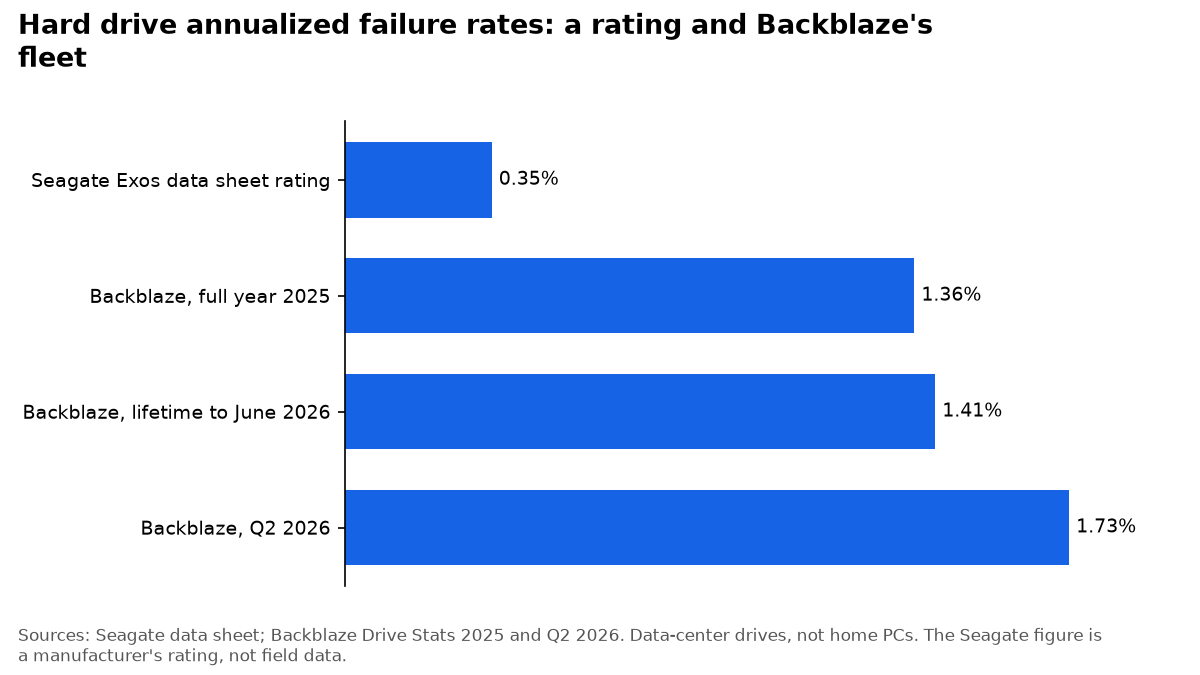
- Backblaze’s cloud data-center fleet recorded a 1.73% annualized failure rate across 354,415 hard drives in Q2 2026, with 1,498 failures over 31,553,350 drive days; this is a server fleet, not home PCs. (Source: Backblaze: Drive Stats for Q2 2026)
- Across its data-center hard drives, Backblaze reports a lifetime annualized failure rate of 1.41% through June 30, 2026, from 21,609 failures over 558,148,607 drive days. (Source: Backblaze: Drive Stats for Q2 2026)
- For full-year 2025, Backblaze’s data-center fleet of 344,196 hard drives across 30 models had an annualized failure rate of 1.36%. (Source: Backblaze: Drive Stats for 2025)
- SSDs used as boot drives in Backblaze’s storage servers had a lifetime annualized failure rate of 0.90% from Q4 2018 through Q2 2023, in a small fleet of 3,144 SSDs at mid-2023. (Source: Backblaze: SSD Edition, 2023 Mid-Year Drive Stats Review)
- Seagate’s data sheet rates its Exos enterprise hard drives at a 2,500,000-hour mean time between failures and a 0.35% annualized failure rate under full 24x7 operation; that is a manufacturer rating, not field data. (Source: Seagate: Exos data sheet (DS2045.4-2511), 2025)
- In a field study of about 100,000 disks at high-performance computing and internet service sites, datasheets implied an annual failure rate of at most 0.88%, yet observed replacement rates were commonly 2-4% and reached 13% on some systems. (Source: Schroeder and Gibson, Disk failures in the real world (USENIX FAST 2007), 2006)
- Google’s study of its own data-center disks, with data collected December 2005 to August 2006, found annualized failure rates from 1.7% for drives in their first year to over 8.6% for 3-year-old drives. (Source: Pinheiro, Weber and Barroso, Failure Trends in a Large Disk Drive Population (USENIX FAST 2007), 2006)
- Over six years of production use in Google’s data centers, 4-10% of flash drives were replaced in a four-year period, while 20–63% of drives, depending on model, had at least one uncorrectable error in their first four years. (Source: Schroeder, Lagisetty and Merchant, Flash Reliability in Production (USENIX FAST 2016), 2015)
- A Microsoft and Penn State study of over half a million SSDs in production data centers across nearly 3 years found that, for some models, the observed annualized failure rate was as much as 70% higher than the rate quoted in specifications. (Source: Narayanan et al., SSD Failures in Datacenters: What, When and Why? (Microsoft Research), 2015)
- A field study of almost 1.4 million SSDs in NetApp enterprise storage systems, over 30 months of telemetry, found an average annual replacement rate of 0.22%, ranging from 0.07% to nearly 1.2% by drive model. (Source: Maneas et al., A Study of SSD Reliability in Large Scale Enterprise Storage Deployments (USENIX FAST 2020), 2019)
- In a consumer survey by Belgium’s Test-Aankoop and partner groups in seven other European countries (31,054 responses, published in 2026), 6% reported a problem with the hard disk or SSD in their laptop, joint second behind the battery at 16%, and the page doesn’t say whether that covers all countries or Belgium alone. (Source: Test-Aankoop: laptop brands survey (Dutch), 2026)
How long PCs last
Published lifespans run from about 4 to 7 years, but they measure different things (a modelling assumption, a policy model, an owner survey), so they shouldn't be averaged.
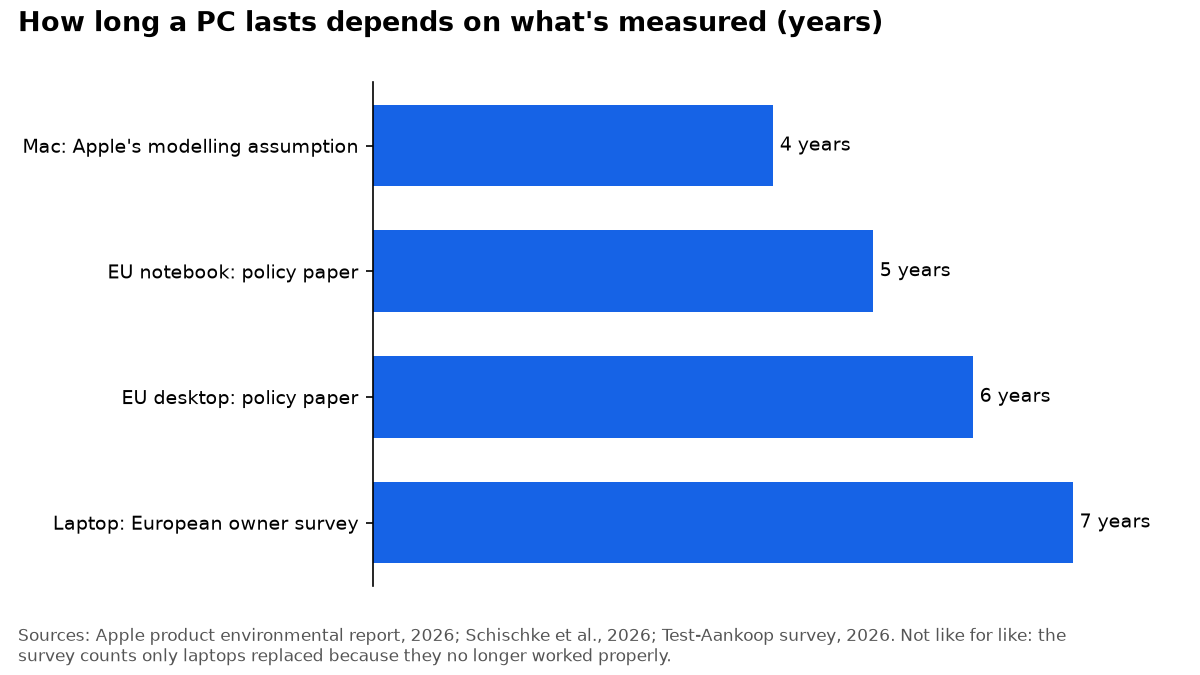
- A consumer survey by Belgium’s Test-Aankoop and partner groups in seven other European countries (31,054 responses, published in 2026) puts the average laptop lifespan at 7 years, counting only laptops replaced because they no longer worked properly; the page doesn’t say whether that covers all countries or Belgium alone. (Source: Test-Aankoop: laptop brands survey (Dutch), 2026)
- In the same Test-Aankoop survey, average laptop lifespan by brand ran from 5 years 3 months (Microsoft) to 8 years 1 month (Samsung), with Apple at 7 years 7 months. (Source: Test-Aankoop: laptop brands survey (Dutch), 2026)
- In the same Test-Aankoop survey, a technical problem was the reason for replacing the laptop in 72% of cases, a definition that covers machines that stopped working, repairs that were too costly or unwanted, no parts or software updates, and laptops that had become outdated and slow. (Source: Test-Aankoop: laptop brands survey (Dutch), 2026)
- A 2026 paper led by Karsten Schischke of Fraunhofer IZM gives the current service lifetime of computers in the EU as 5 years for notebooks and 6 years for desktops, and calibrates its policy model to those values. (Source: Schischke et al., Data analytics to decarbonize computer life cycles, Energy Demand (2026), DOI 10.66506/ed.12)
- In the 2026 EU policy lifetime model by Schischke et al., which the authors call modelling assumptions constrained by field evidence, 50.98% of notebooks survive to year 5 and 18.43% to year 6, for an average lifetime of 5.00 years. (Source: Schischke et al., Data analytics to decarbonize computer life cycles, Energy Demand (2026), DOI 10.66506/ed.12)
- Among more than 250,000 used computers assessed by a large refurbisher, typically after three years of mainly business use, nearly 40% of notebooks and tablets or convertibles had at least one defect, cosmetic flaws included, against under 20% of desktops. (Source: Schischke et al., Data analytics to decarbonize computer life cycles, Energy Demand (2026), DOI 10.66506/ed.12)
- Consumer Reports says 16% of laptops owned by its members broke or stopped working as well as they should within three years, based on 2023-2025 member surveys covering 75,923 portable computers bought new between 2019 and 2025. (Source: Consumer Reports: Most Reliable Laptop Brands of 2026, 2025)
- A November 2009 study by warranty seller SquareTrade of over 30,000 new laptops on its plans found 31% of owners reported a failure in the first 3 years: 20.4% hardware malfunctions and 10.6% accidental damage. (Source: SquareTrade: 1 in 3 Laptops fail over 3 years, 2009)
- Environmental group ECOS said in its 2020 report that consumers expect laptops to work for 7 years or more, while the typical laptop lifetime was 4 to 5 years. (Source: ECOS: Long Live the Machine, 2020)
- Apple’s product environmental reports assume four years of use for a Mac when calculating its carbon footprint; this is an LCA modelling assumption for the use phase, not a measure of how long Macs last. (Source: Apple: MacBook Air (M5) Product Environmental Report, March 2026)
- Gartner forecast in February 2026 that rising memory costs will lengthen PC lifetimes by 15% for business buyers and 20% for consumers by the end of 2026; this is an analyst forecast, not a measurement. (Source: Gartner: Surging Memory Costs Will Reduce Global PC and Smartphone Shipments in 2026)
Repair and right to repair
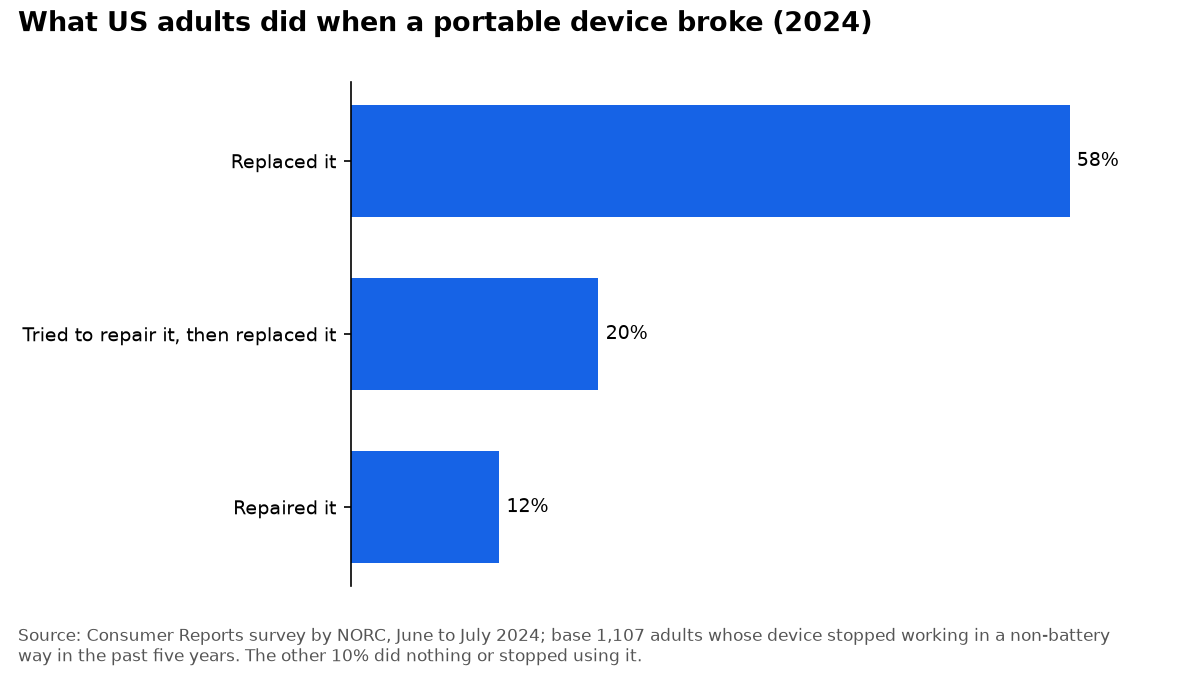
Replacing is far more common than repairing: 12% of US adults whose portable device broke in a non-battery way repaired it, while PIRG's laptop repair grades run from B+ for ASUS to C- for Apple and more states pass repair laws.
- PIRG’s Failing the Fix 2026 scorecard graded laptop brands from B+ (ASUS) down to C- (Apple), with Acer at B, HP, Dell, Samsung and Microsoft at B-, and Lenovo at C; the grades start from France’s repair index and adjust for ease of disassembly and for lobbying on repair laws. (Source: U.S. PIRG Education Fund: Failing the Fix (2026))
- iFixit’s own teardown scoring, on a 0 to 10 scale, gave the 2026 Lenovo ThinkPad T14 Gen 7 and T16 Gen 5 a 10 and the 2025 MacBook Pro 14-inch (M5) a 4, both on scorecard version 2.2; these are scores for individual models, not whole brands. (Source: iFixit: Laptop Repairability Scores, 2026)
- A 2021 PIRG report, restated in its 2026 scorecard, put average US family spending on new electronics at nearly $1,767 a year and estimated that Americans could save a combined $49.6 billion by repairing electronics and appliances instead of replacing them. (Source: U.S. PIRG Education Fund: Failing the Fix (2026), 2021)
- In Consumer Reports’ nationally representative survey of 2,154 US adults (June to July 2024), 12% of the 1,107 respondents whose portable rechargeable device broke in a non-battery way in the past five years repaired it, 58% replaced it and 20% tried to repair it but ended up replacing it. (Source: Consumer Reports: Right to Repair Survey, 2024 topline results)
- In the same Consumer Reports survey of 2,154 US adults in 2024, 62% of the 1,401 respondents whose portable rechargeable device had a failing battery in the past five years replaced the whole device, and 29% replaced the battery. (Source: Consumer Reports: Right to Repair Survey, 2024 topline results)
- The European Environment Agency reports that 59% of respondents in the 2024 Eurobarometer on the environment would pay more for products that are easier to repair, recyclable and sustainably produced, down from 72% in 2007. (Source: European Environment Agency: Public views on the circular economy, 2024)
- US County Business Patterns counted 10,917 establishments with 89,305 employees in electronic and precision equipment repair and maintenance (NAICS 81121) in 2023, an industry that covers more than computers. (Source: US Census Bureau: County Business Patterns 2023, table CB2300CBP (NAICS 81121, United States))
- The US Bureau of Labor Statistics counted 117,700 jobs for electrical and electronics installers and repairers in 2025, a broad occupation not limited to computers, with a median wage of $74,490 in May 2025 and projected employment growth of 2% from 2025 to 2035. (Source: US Bureau of Labor Statistics: Occupational Outlook Handbook, Electrical and Electronics Installers and Repairers, 2025)
- A July 2026 analysis by the law firm Faegre Drinker counted 13 US states with some form of enacted right-to-repair statute, covering products from consumer electronics to farm equipment, cars and powered wheelchairs, up from seven in September 2024. (Source: Faegre Drinker: Unlocking the Right to Repair (July 30, 2026))
- PIRG calculated that 25.75% of Americans would live in a state with Right to Repair protections once six new laws took effect at the start of 2026. (Source: PIRG: More than one-quarter of Americans covered by Right to Repair come Jan. 1, 2026)
- California’s Right to Repair Act (SB 244), operative from July 1, 2024, requires makers of electronics and appliances with a wholesale price of $100 or more to provide repair documentation, parts and tools for at least seven years after a model’s last manufacture. (Source: California Legislative Information: SB 244, Right to Repair Act, 2024)
- EU Directive 2024/1799 on the repair of goods, dated 13 June 2024, required member states to bring the national rules needed to comply with it into force by 31 July 2026 at the latest. (Source: EUR-Lex: Directive (EU) 2024/1799, Official Journal, 2026)
- France’s mandatory repairability index, in place since 1 January 2021, gives products a score out of 10; as of the ministry’s July 2025 update it covered 5 product categories, including laptops, after TVs and washing machines moved to a separate durability index in 2025. (Source: French Ministry of Ecological Transition: Indice de réparabilité, 2025)
E-waste
About a fifth of the world's e-waste is documented as collected and recycled, with small IT equipment at 22%, and the rate varies widely by region, from 42.8% in Europe to 0.7% in Africa.
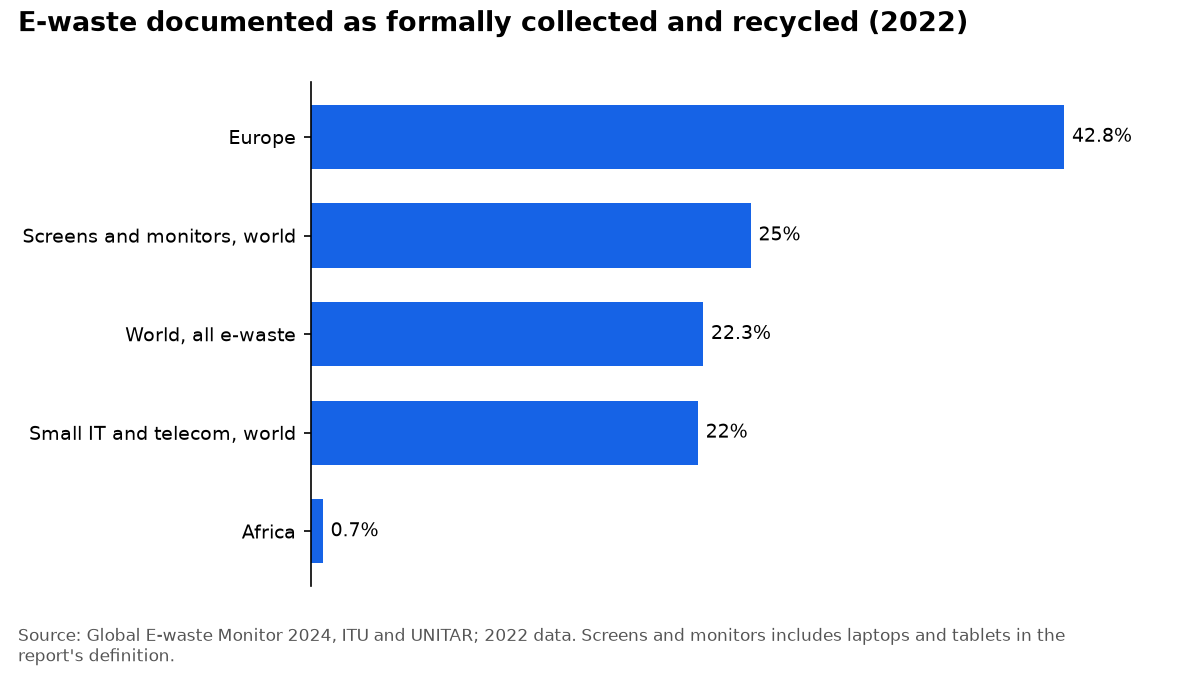
- The world generated 62 billion kg of e-waste in 2022, an average of 7.8 kg per person, and 22.3% of it was documented as formally collected and recycled, according to the Global E-waste Monitor 2024 from ITU and UNITAR. (Source: ITU and UNITAR: The Global E-waste Monitor 2024, 2022)
- Small IT and telecommunication equipment such as phones, routers, personal computers and printers made up about 5 billion kg of global e-waste in 2022 (the report’s own figures for this category range from 4.6 to 5), and 22% of it was documented as formally collected and recycled. (Source: ITU and UNITAR: The Global E-waste Monitor 2024, 2022)
- Screens and monitors, the category the Global E-waste Monitor 2024 defines as including TVs, monitors, laptops, notebooks and tablets, accounted for 5.9 billion kg of global e-waste in 2022, with 25% documented as formally collected and recycled. (Source: ITU and UNITAR: The Global E-waste Monitor 2024, 2022)
- The Global E-waste Monitor 2024 projects from its 2022 baseline that global e-waste will reach 82 billion kg in 2030 and that, on a business-as-usual path, the documented collection and recycling rate will fall to 20%. (Source: ITU and UNITAR: The Global E-waste Monitor 2024, 2022)
- Europe generated the most e-waste per person in 2022 at 17.6 kg, with a 42.8% documented collection and recycling rate, while Africa generated 2.5 kg per person with a 0.7% rate. (Source: ITU and UNITAR: The Global E-waste Monitor 2024, 2022)
- The EU collected 12.3 kg of e-waste per person in 2024, while 32.4 kg of new electrical and electronic equipment per person was put on the market that year, according to Eurostat. (Source: Eurostat news: 12.3 kg of e-waste per person collected in the EU, 2024)
- The EU’s e-waste collection rate was 39.0% in 2024, measured against equipment put on the market in the three preceding years and well below the 65% target; Bulgaria led at 83.1%. (Source: Eurostat Statistics Explained: Waste statistics - electrical and electronic equipment, 2024)
- EU countries collected 411,077 tonnes of small IT and telecommunications waste in 2024, compared with 403,526 tonnes of such equipment put on the market that year, according to Eurostat’s WEEE dataset. (Source: Eurostat dataset env_waseleeos: WEEE by waste management operations, EU27, 2024)
- The US EPA estimated that 2.7 million tons of selected consumer electronics were generated in US municipal solid waste in 2018, with a recycling rate of 38.5%, in a category that includes computer equipment, TVs and phones. (Source: US EPA: Durable Goods, Product-Specific Data, 2018)
- PIRG estimates that Windows 10’s end of support left as many as 400 million otherwise working computers without free support, representing an estimated 1.6 billion pounds of potential e-waste; both are advocacy estimates based on hardware that cannot run Windows 11, not counts of discarded PCs. (Source: PIRG: R.I.P. Windows 10 and hundreds of millions of PCs that depended on it, 2025)
- Canalys Research estimated in December 2023 that the end of Windows 10 support could lead to about 240 million PCs being disposed of, weighing an estimated 480 million kg; this was a forecast made before the deadline, as reported by Reuters. (Source: The Irish Times: Microsoft ending support for Windows 10 could send 240m PCs to landfills, 2023)
Malware and tech support scams
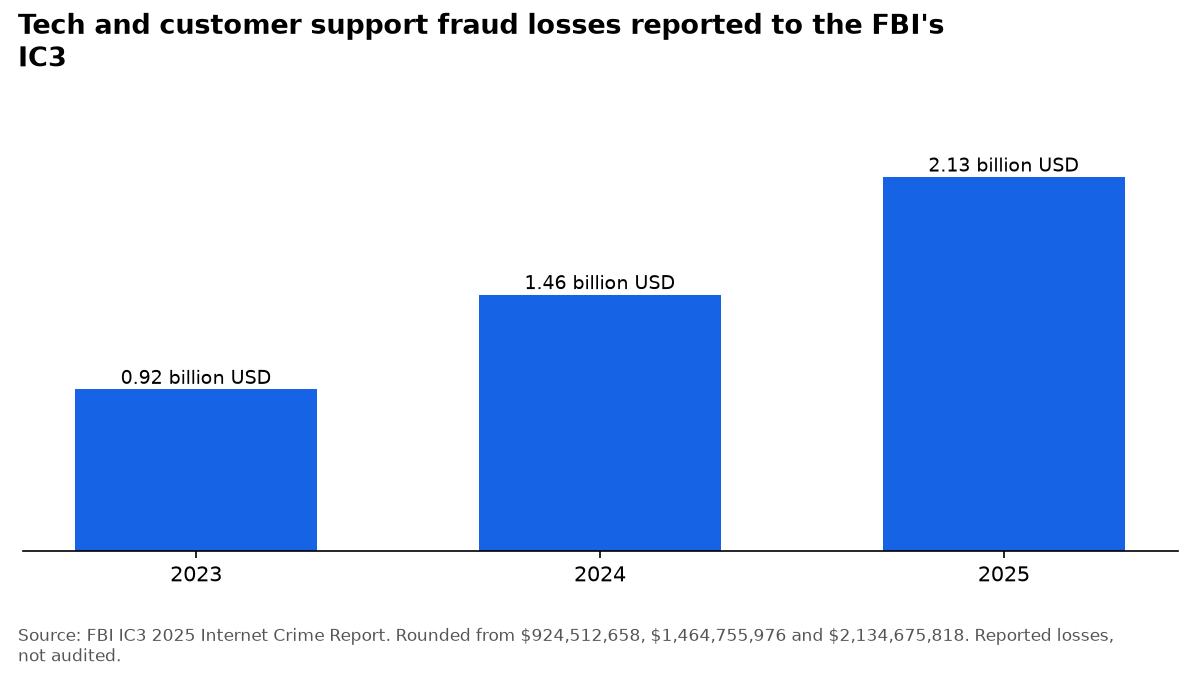
Tech and customer support fraud is a multi-billion-dollar category in FBI complaints, with $2,134,675,818 reported in 2025, though it's wider than PC support, and FBI and FTC counts are separate, so they can't be added or compared as a trend.
- The FBI’s Internet Crime Complaint Center received 47,794 complaints about tech and customer support fraud in 2025, up from 36,002 in 2024. (Source: FBI Internet Crime Complaint Center: 2025 IC3 Annual Report)
- Complainants told the FBI’s IC3 they lost $2,134,675,818 to tech and customer support fraud in 2025, the third-largest loss among its cyber-enabled fraud types after investment fraud and business email compromise. (Source: FBI Internet Crime Complaint Center: 2025 IC3 Annual Report)
- Tech and customer support fraud losses reported to the FBI’s IC3 were $1,464,755,976 in 2024, up from $924,512,658 in 2023. (Source: FBI Internet Crime Complaint Center: 2025 IC3 Annual Report, three-year comparison, 2024)
- Complainants aged 60 and over reported $1,040,730,043 in tech and customer support fraud losses to the FBI’s IC3 in 2025, which is 48.75% of that category’s $2,134,675,818 total ($1,040,730,043 / $2,134,675,818); a later table in the same report prints $1,040,879,243 for this row. (Source: FBI Internet Crime Complaint Center: 2025 IC3 Annual Report, Elder Fraud section)
- Consumers filed 69,221 tech support scam reports with the FTC’s Consumer Sentinel Network in 2024, 1.07% of all Sentinel reports that year, down from 91,234 in 2023. (Source: FTC: Consumer Sentinel Network Data Book 2024, Appendix B3)
- Older consumers reported $159 million in losses to tech support scams to the FTC in 2024. (Source: FTC: Annual report to Congress on protecting older adults (press release), 2024)
- The AV-TEST Institute says it registers over 450,000 new malicious programs and potentially unwanted applications every day. (Source: AV-TEST Institute: Malware statistics, 2026)
- In AV-Comparatives’ Malware Protection Test of September 2026, Microsoft Defender blocked 9,989 of 10,000 samples for a 99.89% protection rate, but raised 28 false alarms, against 1 for the fewest among the 20 products tested. (Source: AV-Comparatives: Malware Protection Test September 2026)
- Ransomware was present in 48% of the breaches in Verizon’s 2026 Data Breach Investigations Report, up from 44% the year before; the dataset covers organizations’ incidents from November 2024 to October 2025, including more than 22,000 confirmed breaches. (Source: Verizon: 2026 Data Breach Investigations Report, 2025)
- Microsoft Defender telemetry recorded ClickFix-style attacks, where a fake prompt gets the user to run an attacker’s command, on more than 1.1 million unique devices between February and early May 2026, roughly an eightfold increase. (Source: Microsoft: 2026 Digital Defense Report)
- Phishing made up 77.8% of the social engineering techniques identified in EU-targeting incidents in ENISA’s analysis of 8 257 incidents recorded during calendar year 2025. (Source: ENISA: Threat Landscape 2026, 2025)
- CISA’s Known Exploited Vulnerabilities catalog listed 1768 vulnerabilities in its 2026.11.04 version, and 390 of them, or 22.1% (390 / 1768), were in Microsoft products, the most of any vendor, ahead of Cisco with 102. (Source: CISA: Known Exploited Vulnerabilities catalog (JSON feed), 2026)
Backups and data loss
Most US computer owners say they back up, but fewer than half do so monthly, and three in four say they have accidentally deleted important data; these are figures from a poll commissioned by a backup company.
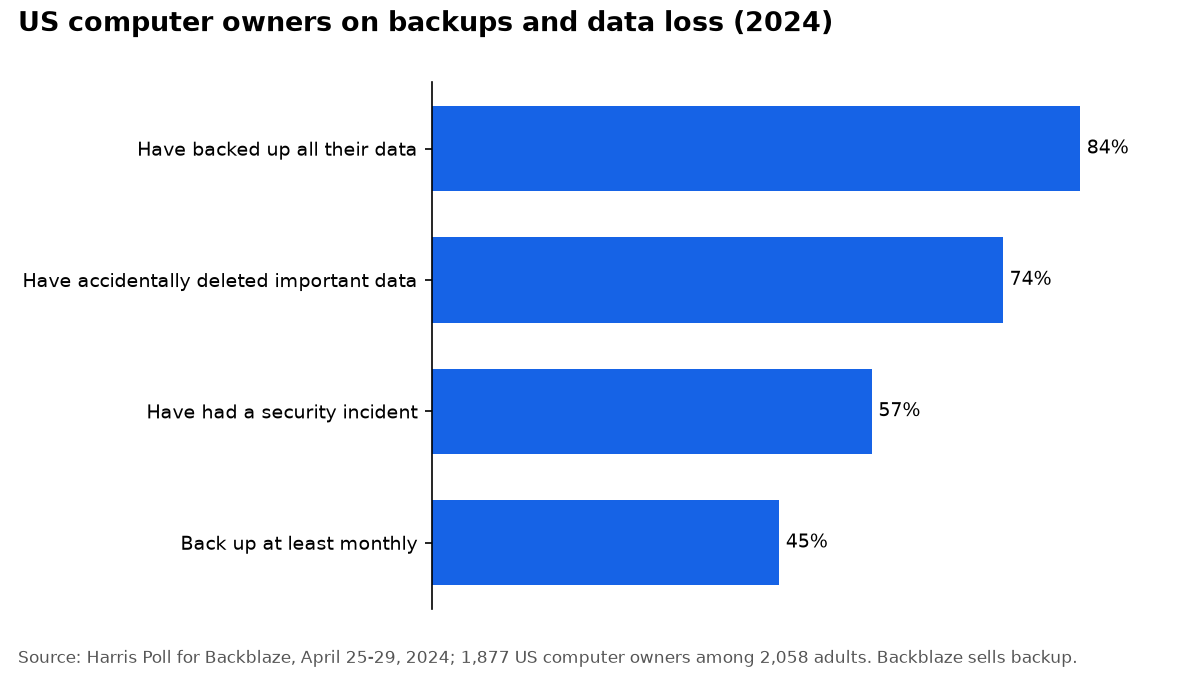
- In a Harris Poll for Backblaze of 2,058 US adults, April 25-29, 2024, 84% of the 1,877 computer owners said they have backed up all their data, but only 45% do so at least once a month. (Source: Backblaze: 2024 State of the Backup)
- In the same 2024 Harris Poll for Backblaze, 74% of US computer owners said they had accidentally deleted important data and 57% said they had experienced a security incident on their computer. (Source: Backblaze: 2024 State of the Backup)
- Among US IT decision makers surveyed by Harris Poll for Backblaze (300 respondents, April 30 to May 8, 2024), only 42% of those whose organizations experienced data loss were able to restore all of their data. (Source: Backblaze: 2024 State of the Backup)
- In a Sophos-commissioned survey of 2,158 IT and cybersecurity leaders at organizations hit by ransomware, in 17 countries, January to March 2026, backups were used to recover data in 66% of attacks where data was encrypted, up from 54% in the 2025 report. (Source: Sophos: The State of Ransomware 2026)
- In Verizon’s 2026 Data Breach Investigations Report, 69% of ransomware victims in its dataset did not pay the ransom, and the median amount paid fell to $139,875 from $150,000. (Source: Verizon: 2026 DBIR Executive Summary, 2025)
- The UK government’s 2025/2026 Cyber Security Breaches Survey, from August to December 2025, found 74% of UK businesses and 57% of charities back up data securely via a cloud service; 2,112 businesses and 1,085 charities took part. (Source: GOV.UK: Cyber security breaches survey 2025/2026)
- The FBI’s Internet Crime Complaint Center received 3,611 ransomware complaints in 2025, with reported losses of $32,320,105; these count only complaints filed with IC3. (Source: FBI IC3: 2025 Internet Crime Report)
The people who fix and code
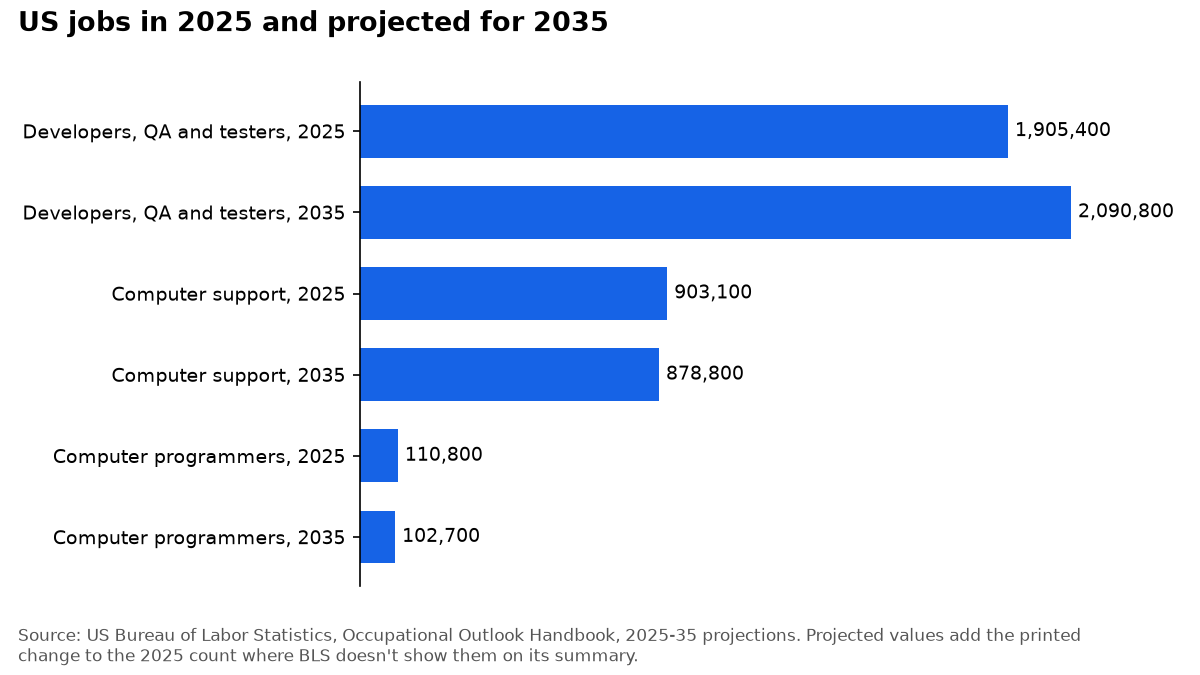
The Bureau of Labor Statistics projects US computer support jobs to shrink 3% by 2035 and software developer jobs to grow 10%, but it also projects computer programmer jobs to fall 7%, so not every coding job is growing.
- US computer support specialists earned a median of $62,890 a year in May 2025, according to the Bureau of Labor Statistics. (Source: US Bureau of Labor Statistics: Occupational Outlook Handbook, Computer Support Specialists, 2025)
- The Bureau of Labor Statistics counted 903,100 US computer support specialist jobs in 2025 and projects 878,800 by 2035, a 3% decline (24,300 fewer), while all occupations are projected to grow 3%. (Source: US Bureau of Labor Statistics: Occupational Outlook Handbook, Computer Support Specialists, 2025)
- US computer user support specialists, the help desk end of the job, held 750,600 jobs in 2025 and are projected to lose 26,200 by 2035 (-3%), with BLS citing automated tools such as chatbots; network support is projected to grow 1%. (Source: US Bureau of Labor Statistics: Occupational Outlook Handbook, Computer Support Specialists, Job Outlook, 2025)
- US software developers, quality assurance analysts and testers held 1,905,400 jobs in 2025, and the Bureau of Labor Statistics projects 10% growth to 2035, or 185,400 more jobs. (Source: US Bureau of Labor Statistics: Occupational Outlook Handbook, Software Developers, Quality Assurance Analysts, and Testers, 2025)
- Software developers alone, excluding QA analysts and testers, held 1,717,800 US jobs in 2025 and earned a median of $135,980 in May 2025, about 2.2 times the $62,890 median for computer support specialists ($135,980 / $62,890). (Source: US Bureau of Labor Statistics: Occupational Outlook Handbook, Software Developers, Quality Assurance Analysts, and Testers, 2025)
- Not all coding jobs are growing: the Bureau of Labor Statistics counted 110,800 US computer programmer jobs in 2025 and projects a 7% decline by 2035, a loss of 8,100. (Source: US Bureau of Labor Statistics: Occupational Outlook Handbook, Computer Programmers, 2025)
- In Stack Overflow’s 2025 Developer Survey (31,569 responses to the question), 49.5% named Windows for professional use, ahead of macOS at 32.9% and Ubuntu at 27.7%; for personal use Windows reached 56.7%. (Source: Stack Overflow: 2025 Developer Survey, Technology, Computer operating systems)
- JavaScript was the most-used language in Stack Overflow’s 2026 Developer Survey, named by 8,742 respondents or 62.0% of those who answered, ahead of SQL at 58.4%, HTML/CSS at 58.2% and Python at 58.0%. (Source: Stack Overflow: 2026 Developer Survey, Technology)
- In Stack Overflow’s 2026 Developer Survey of 30,903 respondents from 169 countries, 32.6% of those answering about job satisfaction said they were not happy at work, 45.1% complacent and 22.2% happy. (Source: Stack Overflow: 2026 Developer Survey, overview)
- In JetBrains’ Developer Ecosystem Survey 2026 (28,945 responses), 66% of the 11,298 developers with Python as a primary language used Windows for their development environment, against 44% of the 1,836 Go developers. (Source: JetBrains: Python vs Go, from the Developer Ecosystem Survey 2026)
- GitHub says it serves more than 225 million developers as of 2026, with the United States at 38.3 million and India at 32 million as the two largest communities. (Source: GitHub Blog: Octoverse 2026)
Methodology
We looked for the organization that collected each number and cited its own page wherever we could reach it. Seven stats cite a reputable outlet, agency or law firm reporting or compiling someone else’s data because the original wasn’t publicly readable, and each of those sentences or source names says so. Vendor data appears only when the vendor collected it itself, and the sentence names whose sample it is. Every number comes from the page it links to, never from a search snippet or a roundup. We checked each stat in two steps: a script fetched every link and looked for the exact number on the page, then we read each sentence against the source to confirm that the population, unit, country and year match. The script can’t read everything: 38 stats were confirmed by hand, 31 of them by extracting the text of a PDF and 7 by reading the page in a browser, which is needed for charts drawn by JavaScript or pages that refuse scripts. Some links go to the data file behind a dashboard, such as the US Census Bureau, Firefox, Eurostat and analytics.usa.gov figures, because that is what we read. Where a data file prints many decimal places we round to two, and anything we calculated ourselves shows its arithmetic in the sentence. We don’t merge sources that disagree. Shipment counts, market shares and lifespan figures differ because they count different things, so each appears with its own source and definition, and they shouldn’t be averaged or added together. Forecasts and modelling assumptions are labelled as such. Most stats describe 2024 or later; older figures stay only where they add history or nothing newer exists. A few live sources will change after this date, including Statcounter, Cloudflare Radar and CISA’s catalog, so their sentences name the period we read. No site-owned data is included. We plan to refresh this page every quarter, or sooner when a major source updates.
Sources
- analytics.usa.gov: analytics.usa.gov (Digital Analytics Program): Operating systems, previous fiscal year
- apple.com: Apple: MacBook Air (M5) Product Environmental Report, March 2026
- article.images.consumerreports.org: Consumer Reports: Right to Repair Survey, 2024 topline results
- assets.sophos.com: Sophos: The State of Ransomware 2026
- av-comparatives.org: AV-Comparatives: Malware Protection Test September 2026
- av-test.org: AV-TEST Institute: Malware statistics
- backblaze.com: Backblaze: 2024 State of the Backup; Backblaze: Drive Stats for 2025; Backblaze: Drive Stats for Q2 2026; Backblaze: SSD Edition, 2023 Mid-Year Drive Stats Review
- blog.jetbrains.com: JetBrains: Python vs Go, from the Developer Ecosystem Survey 2026
- blogs.windows.com: Windows Experience Blog: Stay secure with Windows 11, Copilot+ PCs and Windows 365 before support ends for Windows 10
- bls.gov: US Bureau of Labor Statistics: Occupational Outlook Handbook, Computer Programmers; US Bureau of Labor Statistics: Occupational Outlook Handbook, Computer Support Specialists; US Bureau of Labor Statistics: Occupational Outlook Handbook, Computer Support Specialists, Job Outlook; US Bureau of Labor Statistics: Occupational Outlook Handbook, Electrical and Electronics Installers and Repairers; US Bureau of Labor Statistics: Occupational Outlook Handbook, Software Developers, Quality Assurance Analysts, and Testers
- cisa.gov: CISA: Known Exploited Vulnerabilities catalog (JSON feed)
- commonsensemedia.org: Common Sense Media: The 2025 Common Sense Census: Media Use by Kids Zero to Eight (report PDF)
- consumerreports.org: Consumer Reports: Most Reliable Laptop Brands of 2026
- coolproducts.eu: ECOS: Long Live the Machine
- counterpointresearch.com: Counterpoint Research: Global PC Shipments Plunge 21% in Q3 2026 (October 22, 2026)
- data.census.gov: U.S. Census Bureau: American Community Survey 2024 1-year, Table S2801 (United States); US Census Bureau: County Business Patterns 2023, table CB2300CBP (NAICS 81121, United States)
- data.firefox.com: Mozilla Firefox Public Data Report: Hardware Across the Web, CPU vendor data; Mozilla Firefox Public Data Report: Hardware Across the Web, memory data; Mozilla Firefox Public Data Report: Hardware Across the Web, operating system data
- ec.europa.eu: Eurostat Statistics Explained: Waste statistics - electrical and electronic equipment; Eurostat dataset env_waseleeos: WEEE by waste management operations, EU27; Eurostat news: 12.3 kg of e-waste per person collected in the EU; Eurostat: Digital economy and society statistics, households and individuals
- ecologie.gouv.fr: French Ministry of Ecological Transition: Indice de réparabilité
- eea.europa.eu: European Environment Agency: Public views on the circular economy
- enisa.europa.eu: ENISA: Threat Landscape 2026
- epa.gov: US EPA: Durable Goods, Product-Specific Data
- eur-lex.europa.eu: EUR-Lex: Directive (EU) 2024/1799, Official Journal
- ewastemonitor.info: ITU and UNITAR: The Global E-waste Monitor 2024
- faegredrinker.com: Faegre Drinker: Unlocking the Right to Repair (July 30, 2026)
- ftc.gov: FTC: Annual report to Congress on protecting older adults (press release); FTC: Consumer Sentinel Network Data Book 2024, Appendix B3
- gartner.com: Gartner press release: AI PCs Will Represent 31% of Worldwide PC Market by the End of 2025; Gartner press release: Surging Memory Costs Will Reduce Global PC and Smartphone Shipments in 2026; Gartner: Surging Memory Costs Will Reduce Global PC and Smartphone Shipments in 2026; Gartner: Surging memory costs will reduce global PC and smartphone shipments in 2026 (press release, February 26, 2026); Gartner: Worldwide PC shipments declined 22.4% in Q3 2026 (press release, October 12, 2026); Gartner: Worldwide PC shipments increased 4% in Q1 2026 (press release, April 10, 2026); Gartner: Worldwide PC shipments increased 9.3% in Q4 2025 and 9.1% for the full year (press release, January 20, 2026)
- github.blog: GitHub Blog: Octoverse 2026
- gov.uk: GOV.UK: Cyber security breaches survey 2025/2026
- gs.statcounter.com: Statcounter Global Stats: Desktop OS market share, United States; Statcounter Global Stats: Desktop OS market share, worldwide; Statcounter Global Stats: Desktop Windows version market share, China; Statcounter Global Stats: Desktop Windows version market share, United States; Statcounter Global Stats: Desktop Windows version market share, worldwide; Statcounter Global Stats: Desktop Windows version series, CSV export, Oct 2025 to Oct 2026
- ic3.gov: FBI IC3: 2025 Internet Crime Report; FBI Internet Crime Complaint Center: 2025 IC3 Annual Report; FBI Internet Crime Complaint Center: 2025 IC3 Annual Report, Elder Fraud section; FBI Internet Crime Complaint Center: 2025 IC3 Annual Report, three-year comparison
- idc.com: IDC: 2025 Holiday PC Shipments Exceed Expectations (press release, January 12, 2026); IDC: PC Market Woes Continue, Shipments Fall 20.1% in Q3 2026 (press release, October 8, 2026)
- ifixit.com: iFixit: Laptop Repairability Scores
- irishtimes.com: The Irish Times: Microsoft ending support for Windows 10 could send 240m PCs to landfills
- itu.int: ITU: Measuring digital development, Facts and Figures 2019
- jonpeddie.com: Jon Peddie Research: Q2’26 PC graphics AIB shipments
- lansweeper.com: Lansweeper: Windows 10 Holdouts Carry Three Times the Risk of Windows 11
- learn.microsoft.com: Microsoft Learn: Extended Security Updates (ESU) program for Windows 10; Microsoft Learn: Windows 10 Home and Pro lifecycle
- leginfo.legislature.ca.gov: California Legislative Information: SB 244, Right to Repair Act
- microsoft.com: Microsoft Fiscal Year 2026 Second Quarter Earnings Conference Call; Microsoft: 2026 Digital Defense Report; Narayanan et al., SSD Failures in Datacenters: What, When and Why? (Microsoft Research)
- nces.ed.gov: NCES Digest of Education Statistics 2024, Table 702.12
- ntia.gov: NTIA: Internet Use Survey dataset, Data Explorer analysis table
- omdia.tech.informa.com: Omdia: Global PC shipments fall 21% in 3Q26 as pull-forward demand subsides (press release, October 9, 2026)
- pc.watch.impress.co.jp: PC Watch (Impress) reporting Techno Systems Research at IDEMA Japan, HDD market; PC Watch (Impress) reporting Techno Systems Research at IDEMA Japan, SSD market
- pewresearch.org: Pew Research Center: Americans’ Use of Mobile Devices in 2026 (fact sheet); Pew Research Center: Teens, Social Media and Technology 2024
- pirg.org: PIRG: More than one-quarter of Americans covered by Right to Repair come Jan. 1; PIRG: R.I.P. Windows 10 and hundreds of millions of PCs that depended on it; U.S. PIRG Education Fund: Failing the Fix (2026)
- radar.cloudflare.com: Cloudflare Radar: HTTP requests by operating system, desktop, likely human
- reference-global.com: Schischke et al., Data analytics to decarbonize computer life cycles, Energy Demand (2026), DOI 10.66506/ed.12
- seagate.com: Seagate: Exos data sheet (DS2045.4-2511)
- squaretrade.com: SquareTrade: 1 in 3 Laptops fail over 3 years
- static.googleusercontent.com: Pinheiro, Weber and Barroso, Failure Trends in a Large Disk Drive Population (USENIX FAST 2007)
- store.steampowered.com: Steam Hardware & Software Survey, October 2026
- survey.stackoverflow.co: Stack Overflow: 2025 Developer Survey, Technology, Computer operating systems; Stack Overflow: 2026 Developer Survey, Technology; Stack Overflow: 2026 Developer Survey, overview
- test-aankoop.be: Test-Aankoop: laptop brands survey (Dutch)
- tomshardware.com: Tom’s Hardware reporting Jon Peddie Research Q2 2026 AIB data; Tom’s Hardware reporting Mercury Research Q2 2026 CPU share
- trendforce.com: TrendForce press release: AI Server Demand Sustains Memory Contract Price Increases in 4Q26
- usenix.org: Maneas et al., A Study of SSD Reliability in Large Scale Enterprise Storage Deployments (USENIX FAST 2020); Schroeder and Gibson, Disk failures in the real world (USENIX FAST 2007); Schroeder, Lagisetty and Merchant, Flash Reliability in Production (USENIX FAST 2016)
- verizon.com: Verizon: 2026 DBIR Executive Summary; Verizon: 2026 Data Breach Investigations Report
- web.archive.org: Statcounter Global Stats: Desktop OS market share, Internet Archive capture of July 9, 2026